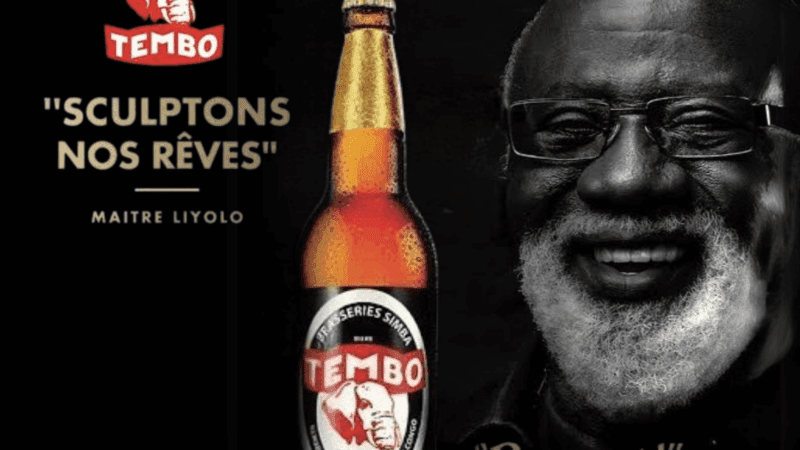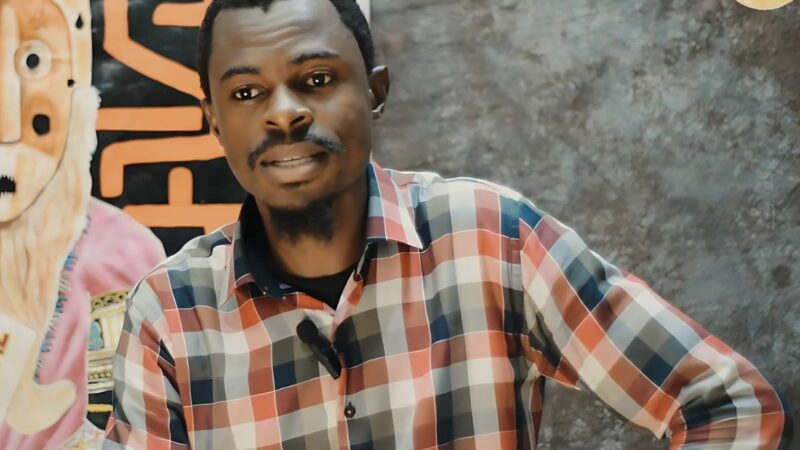
Tembo beer tribute graphic honoring Maître Liyolo, showing a bottle beside a smiling portrait of the sculptor with the slogans 'Sculptons nos rêves' and 'Respect!'.
Essays

From Bolobo to Kōkyo: An Homage to Alfred Liyolo

Walk through Kinshasa today, and you’ll encounter Alfred Liyolo’s legacy in two forms: bronze sculptures gracing public squares and his smiling face on Tembo beer advertisements throughout the city. That a beloved Congolese beer brand chose an artist to represent their product speaks volumes about how Liyolo captured the nation’s heart.
The journey from Bolobo, a humble riverside town on the Congo River where Liyolo was born in 1943, to Kokyo (Tokyo’s Imperial Palace) where he became the first and only African artist ever received by Emperor Akihito, is extraordinary. This is the story of how a grandson of an ivory carver transformed bronze into bridges between worlds, proved that art could speak to emperors and common people alike, and became a symbol of Congolese pride served with every bottle of beer in the nation’s capital.

Read More
an image of the congolese artist Phinet kisimba talking about one of his artworks on video
Meet the Artwork

“Rites de Passage” by Phinet Kisimba

Phinet Kisimba returns with a quieter painting than Sala Po Ozala and a harder subject. A woman in a yellow turban sits thinking against a red that stands for her period, while the ceremony that once would have guided her hangs on the wall in a frame. In the video, Kisimba calls on mothers and wise women to take back a role that has lapsed: menstruation, he says, is not a taboo subject.

Read More
The untold story of antoinette lubaki
Essays

The Untold Story of Antoinette Lubaki: Congo’s Avant-Garde Female Artist

Antoinette Lubaki painted in colonial Katanga in the 1920s alongside her husband Albert. Their watercolors traveled to Brussels, Geneva, and Paris, and were filed under his name. What the colonial archive missed was a partnership in which the visual language came from her side, carried from the mural tradition she grew up in into a marriage that worked as one. This article traces what their work actually was, how it was absorbed into a single masculine signature, and what an honest recovery looks like when the goal is not to flip the erasure but to retire it.

1 Comment Read More
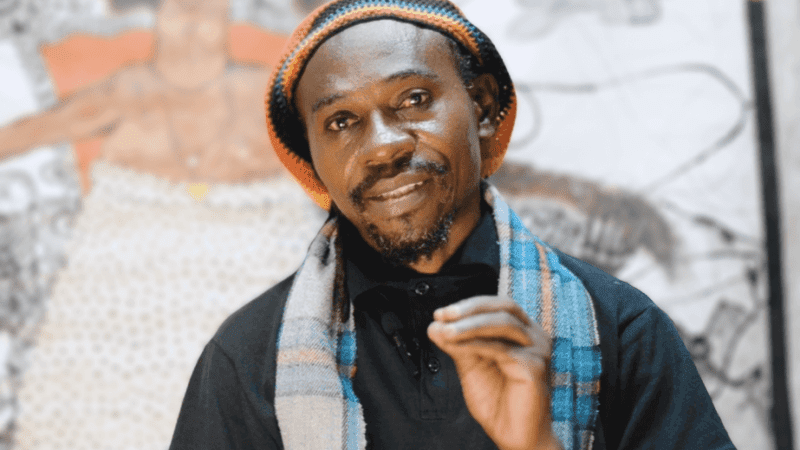
Artist Patrick Kusakana smiling in a knitted hat and blue plaid scarf, gesturing with one hand in front of a large black-and-white artwork.
Meet the Artwork

“Queen Mambueni” by Patrick Kusakana

Patrick Kusakana paints ancestral power as a family matter. La reine Mambueni is his grandmother, the nganga-kisi who healed whatever troubled the family, enthroned here on a red stool with ivory on her face and her arms spread the width of the canvas. In a short video, he explains the black and white, the tusks, and the animals she protects.

Read More
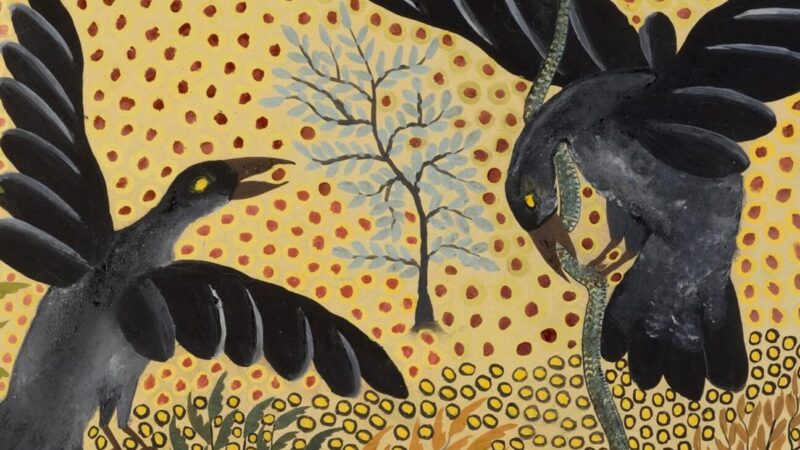
Painting by Pilipili Mulongoy of two black birds, one clutching a snake in its beak, amid a pale tree and foliage on a yellow ground stippled with red dots.
Interviews

Pilipili Mulongoy: A Master’s Story in His Own Words

In a rare 1979 interview, Pilipili Mulongoy—once a humble plumber—reveals how sketching a simple wooden figure ignited his rise to prominence in modern African art. Raised by a master drummer, he first learned the communal power of creativity before honing his signature “petit point” style under mentor Pierre Romain-Desfossés. Now, his reflections illuminate the unbroken thread between traditional craftsmanship and modern expression. Discover how one man’s relentless curiosity bridged worlds and inspired a new generation of Congolese artists.

2 Comments Read More
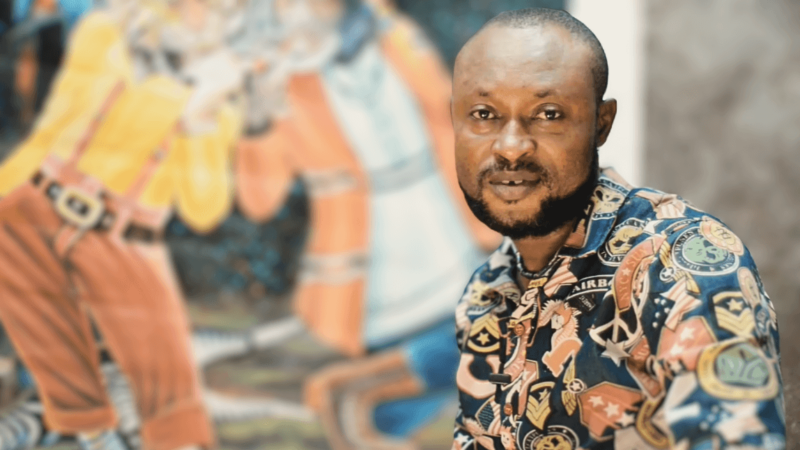
Congolese artist Claude Bosana sits in front of a colorful painting of anthropomorphic animals, wearing a patterned shirt and looking at the camera.
Meet the Artwork

“Intérêt Commun” by Claude Bosana

Claude Bosana, Œil d’Aigle to Kinshasa’s art world, paints a tiger and a bonobo who cannot live together sharing the one interest they have in common: a cigarette. His advice is aimed at the people who hold a portion of authority. On the ground where they stand, the fruit set aside will keep. The zebra will not.

Read More
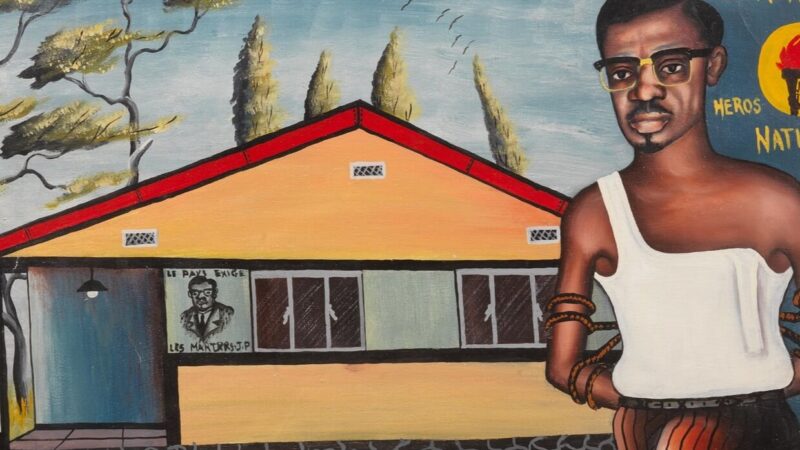
A painting by Tshibumba Kanda Matulu depicting Patrice Lumumba, bound and wearing a torn white tank top, standing in front of a house. The artwork includes text honoring Lumumba as a national hero and references his unmarked grave in Lubumbashi.
Essays

A Visual Tour of Congo History (Part 2): Patrice Lumumba – The Making of an African Legend

Through TKM’s extraordinary paintings, we pay homage to Patrice Lumumba, 64 years after his assassination. Here was a man whose words proved so dangerous that his enemies not only killed him, but tried to erase every trace of his existence – dissolving his body in acid and mysteriously “losing” nearly all recordings of his powerful speeches. Malcolm X called him “the greatest black man who ever walked the African continent,” yet his story remains surprisingly undertold. Following TKM’s visual testament, we uncover the journey of an African hero who dared to speak truth to power, who fought with words rather than weapons, and whose vision of true independence was so threatening that even six decades later, we’re still discovering how thoroughly his voice was suppressed. This is not just a retelling of history, but a tribute to a man whose dream of African dignity and real freedom remains as vital today as it was in 1961.

No Comments Read More
Congolese artist and painter Billy Gibula wearing a plaid shirt, speaking with a focused expression. Behind him, a painting featuring a stylized mask and bold orange text is partially visible.
Meet the Artwork

“Non au Tribalisme” by Billy Gibula

Billy Gibula, painter and one of Kitokongo’s founders, answers tribalism with a figure who wears the argument: a wooden mask above a boldly printed shirt, a banner reading NON AU TRIBALISME across the chest, and, just below the banner, a machete at rest in a hand painted every color at once. In the video he says why: we are all human, all one family, and love must reign.

No Comments Read More
A painting by tshibumba kanda-matulu (TKM) about belgian rule in Congo called: Culture obligatoire
Essays

A Visual Tour of Congo History (Part 1): From Stanley to Belgian Rule

Through five striking paintings by Congolese artist Tshibumba Kanda Matulu, discover how colonial power was established in Congo, from Stanley’s first arrival to Belgian rule. His artwork reveals the calculated stages of colonial control: exploration, betrayal, deception, and systematic elimination of indigenous power. This visual journey through history, seen through Congolese eyes, reveals how one of history’s most brutal colonial enterprises was built – and the extraordinary resilience of those who endured it. More than historical documentation, these paintings offer a uniquely Congolese perspective on events usually told by Western voices.

No Comments Read More
Congolese artist Winnart Nsangu wearing a white shirt, sitting in front of a colorful artwork featuring a stylized face with vibrant green and yellow elements. He has a warm smile and a relaxed posture, with a microphone clipped to his shirt.
Meet the Artwork

“Kin Eza Mboka Na Nga” by Winnart Nsangu

Winnart Nsangu’s Kin Eza Mboka Na Nga (Kinshasa Is My City): a man painted in full color against a Paris that stays a sketch. Nsangu usually leaves his faces without eyes. Here the eyes push through rose-tinted glasses, and they are looking at home.

Read More
Pierre Romain-Desfossés and famous congolese painters at Le Hangar art workshop in Lubumbashi DRC
Essays

The Illusion of Art: Le Hangar and the Colonial Propaganda

Have you encountered yet another glowing tribute to “Le Hangar,” the supposed birthplace of modern Congolese art? Open any book about Congolese art history and three colonial names inevitably dominate the narrative: Georges Thiry, Pierre Romain Desfosses, and Laurent Moonens – as if Congolese art began with their “discovery.” This persistent colonial lens transforms art histories into tributes to European “mentors,” erasing centuries of pre-existing artistic traditions. Behind Le Hangar’s carefully curated image lies a darker truth: it served both as Belgium’s desperate attempt to rebrand its brutal colonial image into that of a “cultural protector,” and as a sophisticated system for controlling and profiting from Congolese art.
This essay examines both local and global contexts to expose how Le Hangar served not as an artistic sanctuary, but as a tool of colonial propaganda and economic exploitation—a reality that still shapes how Congolese art history is told today.

No Comments Read More
Congolese artist Gédéon Ndonda wearing a checkered shirt and glasses, sitting in front of a colorful painting. The artwork behind him features a striking figure with glowing eyes, abstract elements, and vivid colors, blending futuristic and traditional themes.
Meet the Artwork

“Le Réveil d’un Géant” by Gédéon Ndonda

Gédéon Ndonda introduces himself in the video with one commitment: he paints in the style populaire. In Le Réveil d’un Géant (oil on canvas, one meter square), his one-sentence message, that Africans should wake up and take their destiny into their own hands, becomes literal painted hands: one balancing the Earth on its fingertips, one lying open beneath a circuit board, while an old merman at the edge of the scene raises a horn to his lips.

Read More