The Académie des Beaux-Arts de Kinshasa, known as ABA, was once the most prestigious institution in Congo. Under Mobutu it built monuments for the nation, and its graduates formed the country’s cultural elite. To study there meant something.
Today the academy is held back by a broken administration and fading relevance. Its curriculum, despite repeated reform, stays anchored in the European traditions of the school’s colonial founding in 1943, producing graduates who often struggle to find a footing outside its walls.
Another system has done that work all along, and done it well. In workshops across Kinshasa, master painters train apprentices by practice, in a pattern older than the academy itself: watching, assisting, repeating, earning trust by hand. Chéri Samba, Bodo, Tshibumba, and the painters around them learned their craft this way, on billboards and shop signs, and most never set foot in an art school. Their work now hangs in international museums and holds the attention of serious collectors. It is a full education in its own right, one the academy was built to supersede and has never stopped looking down on.
The reversal raises a plain question. What happens when the street, not the academy, produces the artists who matter, while the academy looks past them and past its own silence? The two have always traded more than either side admits, and the street is not the academy’s informal shadow. It is the older school.
From Belgian Priests to Universal Form
ABA was born colonial. It opened in 1943 as a Catholic mission school in Kongo-Central, the École Saint-Luc, and reached Kinshasa later under the grand French name it carries now. Its job was the colony’s job: to turn out les évolués, the “evolved” Congolese who could staff administrative and cultural roles without unsettling Belgian rule. It arrived as if into a void, but there was no void. Congo had made and taught art long before the school, the masks and figures and objects that European hands would carry into glass cases and label art primitif, craft, curiosity, ethnographic specimen, or raw material for European modernists, but rarely the work of artists with knowledge of their own. The academy set out to civilize what was already there.
The name carried the weight of that inheritance. As Chéri Chérin has pointed out, the word academy already implies that European method is the only road to mastery. It announced a hierarchy.
The early school practiced a strange contradiction. It wanted to keep the “exotic” qualities collectors prized while raising the technique to European standards. Call it academic primitivism: students learned European methods the better to render African subjects, preserving the otherness Europe wanted to buy while proving they could handle a brush. It was colonial instruction in the clothes of education, teaching Congolese to see themselves through European eyes, only with cleaner brushwork.
Mobutu’s authenticité campaign changed the terms. For all its faults, it demanded art that served Congo rather than European fantasy. The colossal monuments still standing across Kinshasa make the case: confident, public, addressed to Congolese rather than foreign viewers. For once the academy made work for its own people.
Here the rhetoric and the experience diverge. Under its current director, Henri Kalama, the academy frames its program in the language of decolonization, experimentation, and Congolese forms. Students and recent graduates tell a different story. The path, they say, still runs through a Western master, copied for two years or more, with a student’s own voice held back until the end. There is a difference between learning from a master and spending years muffled inside his hand. What the students want is room to test their own voice alongside the discipline, not only once the imitation is done.
That idea of decolonization leans toward leaving cultural specificity behind, favoring abstract work that could come from anywhere. The irony is hard to miss. In the name of breaking from Europe, the curriculum ends up more European than before. The notion that real art rises above place is a particular idea with a European pedigree, running from Enlightenment claims about universal aesthetic judgment to the modern museum that strips an object of its context to admire pure form. And the stripping is selective. Origin is a burden the Congolese work must shed and a virtue the European work gets to keep.
The contradiction runs deeper than irony. An academy cannot decolonize while it still enforces the colonizer’s verdict, that the art made in its own city, by the tradition it was built to replace, is craft and not worth its walls. Decolonization that leaves the old hierarchy standing is only its newest disguise.
The Older School
The École Populaire was never founded, because it was never new. The workshop, the master, the apprentice learning by doing: this is how Congo taught its art long before any academy existed, and it never stopped. What the academy claimed in 1943 was the title, not the teaching. By the 1970s only an ABA graduate could call himself an artist, and everyone else, however skilled, was filed under craftsman or sign painter. The academy held a monopoly on the title and on taste. It never held one on the teaching itself.
Chéri Samba reached Kinshasa in 1972, a village boy who found work painting billboards on Kasa-Vubu Avenue. Chéri Chérin painted advertisements and shopfronts, whatever paid. They had skill, clients, and something urgent to say about the city swelling around them. So they signed their commercial work. They added commentary, turning a billboard into a story. Samba noticed that a few lines of text made passersby stop and read; a glance became attention. They painted the texture of urban life: corruption, sex, the daily work of survival. No European master had painted these things. No curriculum covered them.
The official art world still dismissed them as commercial painters. Then Badi-Banga, a poet and influential critic, refused the verdict. He did not invent a movement; he named one that was already there, rejecting a version of the same judgment colonialism had passed on the masks and figures, that this was craft and not art. In the mid-1970s he convened a meeting between ABA graduates and self-taught painters. Chéri Chérin sat in an odd spot in that room, an ABA alumnus trained in ceramics rather than painting, who had drifted toward the street on his own. The movement did not rise outside the academy so much as around it, taking in even the people the academy had trained and failed to hold. Its engine was collision.
Badi’s 1978 exhibition in Kinshasa, Art Partout, shifted everything. Billboard painters stood in a gallery as artists, their work shown as a serious form. He gave them the words they had lacked: they were artists, and the popular art they made belonged to the city that made it. Recognition pulled in others. Workshops formed around the established painters, where younger artists learned by watching, mixing color, and blocking in backgrounds. No fees, no prerequisites, no theory before the work began. You learned by doing, earned your place by helping, and graduated the day someone bought your work. The city did the teaching.
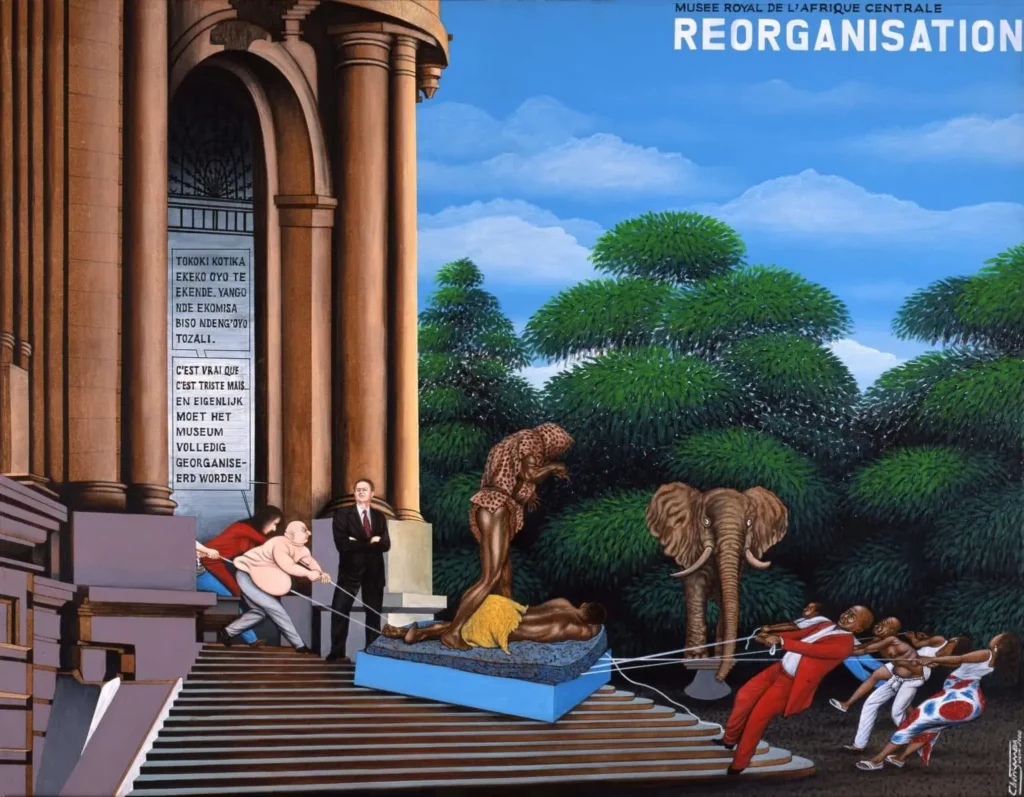
Years later, Samba turned that idiom on the institution itself. Take Réorganisation (2002), commissioned, with some irony, by the Royal Museum for Central Africa in Belgium. It shows a tug-of-war on the museum’s steps over its notorious Leopard Man, a colonial fantasy of African savagery: museum staff haul the statue back inside while Congolese figures drag it out. The composition is something an academy would recognize, balanced, diagonal, and tense. The handling, however, is pure street, flat billboard outlines and block text across the top. The painting says in one image what institutional decolonization says in a hundred pages, and a Congolese viewer takes it in at a glance.
Why One Worked
Three things separate the street from the academy: generational revolt, sheer necessity, and a rough kind of merit. Each explains why the academy stalled while the older way kept producing the work that gets noticed, though the same forces that make the street strong also mark its limits.
First, revolt. Many of today’s students are tired of a globalism that asks them to drop their own context at the door. The popular movement showed that recognition could follow authenticity rather than assimilation. Now even people inside the institution are asking why they should trail dead Europeans when the living city has already cut a path.
Then, necessity. The popular painters did not choose the street for aesthetic reasons; they painted because they had to eat. For every Chéri Samba there were painters who stayed on the avenue, skilled and unknown. Necessity sharpens the few it does not crush. What it gave the work was urgency: flour sacks for canvas, local pigments for paint, and no room for exercises that led nowhere. Each stroke had to earn its place.
Finally, merit. Out of this came a harsh meritocracy. A young painter walks up to a master, brush in hand. The master watches him work and judges whether he can paint and whether he can learn, and that is the whole entrance exam. The academy once had its own version of this, but that has slipped. Access now turns on money and connection more than on ability. The opaque scholarship system current students describe is only the visible edge of it.
The street’s way has its own real costs. The workshop runs on free apprentice labor and offers no protection when a season goes badly. It preserves almost nothing, no archive and little theory beyond what a master carries in his hands. The academy, for all its faults, still buys a student something the street withholds: time to fail without starving, a credential that travels, and structured technical training. The cleanest version of the story, street good and academy bad, is too clean.
The Verdict
Ask a young painter in Kinshasa who inspires her, and she will not reach for Van Gogh or Caravaggio. She will point to the billboard on her corner, the one Chéri Chérin painted, or remember the day a neighbor’s canvas drew a foreign collector. Inspiration comes from proximity more than from history. The popular painters are the proof: you can paint in Lingala and still be heard far away, and you do not have to become someone else to become someone.
The academy, meanwhile, faces the wrong way, still intent on the approval of Europe’s schools while the city at its gate goes unseen. It reads none of the signals, not its own faded influence, not the painters down the road whose work is shown in Paris. An institution that cannot see its own decline cannot begin to reverse it.
I will not write the academy’s obituary. It still gives the young what the street cannot, and that is not nothing. But its monopoly fell in stages, and only the first is finished. Badi-Banga broke the claim on the title in 1978; the claim on the teaching survived. No one forced the academy to hang a popular painter where students copy, and a victory won in a gallery decays with the critic who argued it. One built into a curriculum can outlast him. The street has not stormed the building; it has made it less interesting. You can read the shift in every foreign exhibition that includes a popular painter, and every young artist who picks a workshop over a classroom.
None of this means the street is safe. It thrived, then thrived too fast. The foreign market that found it turned some studios into factories and access into a family business. That damage begins with the market, but the street’s informality leaves it few defenses. That is a story for another essay.
An Opportunity, Easily Wasted
Here is a fact that should trouble ABA. Art populaire has already been taken seriously everywhere, just not at home. The Kinshasa painters hang in the Pompidou and MoMA, and foreign scholars have studied the movement for decades. What ABA files under craft, the world hangs as art.
The deeper trouble is not the copying, which is how anyone learns a craft, but the canon it copies from: a closed list of European names received as if handed down. No canon was ever fixed. The European one grew by taking in outsiders: the Salon turned the Impressionists away before it claimed them, and Caravaggio scandalized the respectable world before museums made him indispensable. A canon never stops adding from the edges.
The street is the edge here. A real academy would do with it what academies eventually do with the work they first refused: study it, argue over it, and put its best on the wall. Samba and Chérin would teach beside the Congolese moderns, beside Ben Enwonwu and other African masters, beside the Europeans too, none of them the standard the others are measured against.
This is not a new idea so much as the half of 1978 that never happened: the gallery opened to the painters, and the classroom never did.
The traffic would run both ways. A street master could stand at the front of an ABA studio, paid and titled like any professor; a student could spend a term in Masina Sans Fil, apprenticed to a popular painter, learning what no studio teaches: speed, nerve, and how to make a picture a stranger reads without a label.
Such a school would also have to teach what the street learns too late: how to meet a foreign market without being remade by it. Leaving the academy never meant leaving the West behind; it swapped the master to copy for the collector to please. It would mean teaching the practical defenses, how a contract works, how a gallery prices, how a buyer turns “authenticity” into a style, and then the harder question, the one no one asks the students aloud. What do you paint when the crowded scene that means everything in Masina Sans Fil travels badly, and a cleaner, sadder, more exportable version sells?
None of this is a formal plan, and I distrust essays that end with one. The street is harsh, the academy a kind of luxury, and what I have set down is only what might pass between them if either decided the other was worth the trouble. Some things grow in the open and die under a roof, and I do not know which this would be. But it seems worth saying, since it is still so rarely said in Kinshasa, on either side of the wall.
Comments
Vive la rue!!