We went early, and Ndjili at dawn let us in. Liberty Market was stirring, but the alleys behind it were still half empty. After the market the streets stopped being streets and became corridors of packed dirt, too narrow for a car to feel welcome. We asked again and again. In Kinshasa, asking is not a failure of planning. It is the map.
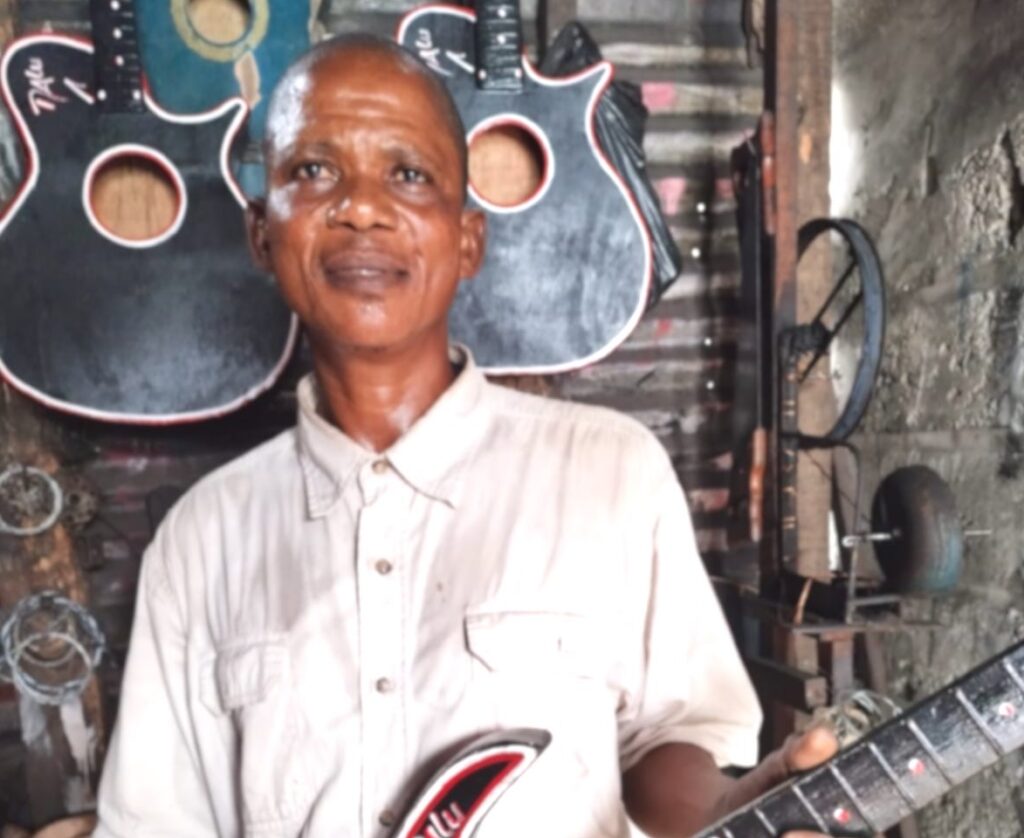
Then an alley opened onto a row of ateliers and small businesses, and Malu was there: a workshop of scrap metal, no more distinguished from its neighbors than one voice in a choir. The modest sanctuary of the written profile is, on the ground, a shed among sheds. The air still held the night’s coolness. Inside: wood, unfinished necks, a few unsold guitars, the three tools that do most of the work.
Maître Mangwala Misoko Mbuta was there, and so was his family. That matters more than the architecture. The youngest child seemed born into the instrument. He did not approach the guitar as a student approaches a lesson. He played with a technique that was already his and sang with a voice larger than the room. The craft here is a father’s trade, and it is also the air the children breathe.
We stayed a long time. The conversation was not an interview with a beginning and an end. It was the slow talk of a man explaining why he left teaching after more than thirteen years, why a guitar and not a table, why he invented a machine to wind his own strings, why he still shapes a neck with a machete. He came to the bench before he came to the classroom. As a boy he built his own instruments, then a guitar of his own; the family had artisans and musicians in it before it had a teacher. Teaching was the detour. He does not describe the return as a sacrifice. He loves the work, and in Kinshasa that sentence is not a slogan but an economic fact spoken against the grain. Money limits what he can buy. It has not touched the decision to stay.
Strings are the part of a guitar a Kinshasa luthier cannot easily buy, so he built a device to wind them, and he made a La for us while we watched, the A string, wire turning on wire until it became a note. The neck is another matter. It comes out of a block under a machete, the same tool that opens a coconut, and by the end of the cutting it has a curve you would not think a blade that size could find. Three tools, a homemade winder, a machete. What leaves the shop does not look like what went in.
Once the workshop had many apprentices. Now the only one left is his son, who works the wood beside him. Watching the younger boy play, you understand both the fragility of the line and the reason it has not broken. Whatever happens to the apprentices of Ndjili, this workshop has its next two occupants sitting in the room.
Leaving was another city. By then every shutter was up, the corridors were full, and some of the passages we had used on the way in were closed: residents stood in the roadway, done with cars cutting through their lives, and that was the law now. We reversed for the market trucks and tucked into side openings when someone was kind enough to wave us in. A preacher saw a mundele, a white man, at the wheel and planted himself in front of the car, announcing the devil inside it to whoever would gather. Billy and I got out. Standing up changed the scene; he talked, then left, and the watchers went back to their own business. Further on, at a corner, mamas drinking Nkoyi at noon slid a broken plastic vuvuzela under the car and performed the accident: look what you have done, ten dollars. I laughed. Ten became five, five became one, and then we were all laughing, and they helped us forward. The advice given to expats in this city, glass up, eyes forward, ignore whoever speaks, produces exactly the hostility it claims to prevent. Get out of the car and Kinshasa mostly turns out to be people.
None of that was the point. It belongs in the account only because the workshop cannot be separated from its street. Nobody reaches Malu on a tourist loop. You reach it through Ndjili’s actual geometry, and the guitars carry that geometry with them. They are not charming despite Kinshasa. They are charming the way Kinshasa is: irregular, negotiated, handmade under pressure, capable of turning a bad opening into a shared joke.
What stays is the man and the wood. A teacher who returned to strings. A machine that makes a La. A son at the bench, and a child in the corner playing something that was already his, in a shed that looks like scrap until you hear what comes out of it. We left without a guitar, and that is the part of the morning we got wrong. There is nowhere else to buy one of these. The strings are wound on a machine that exists only in this room, the neck comes out of a block under a machete, and no two of them look alike, because no two were made on the same day by a man in the same mood. A factory can make an instrument. This is a man who chose the workshop over a salary and builds, one at a time, the thing he wanted to hold as a boy. Billy and I talked on the way out about coming back, about him painting a few of the bodies so they might find buyers faster, and like other plans made in a car in Kinshasa it went under the next thing. The guitars are still there.
Comments