In November 2015, André Magnin told the Paris magazine Crash how Congolese painting came to exist. His exhibition Beauté Congo 1926–2015, the largest of Congolese art ever mounted, was still on at the Fondation Cartier. Since 1926, he said, Congo had benefited from a series of small “miracles.”
The printed text puts the word in quotation marks every time.
The miracles arrive in three claims.
Paper. Certain artists became precursors because they were first to access paper and watercolors. The painters who decorated huts had only earth, ochre, and charcoal.
Freedom. At every turn, independent and passionate individuals ensured the artists enjoyed complete freedom. Foreign backers shielded them from the kind of education that might have spoiled them.
Lineage. No group of painters influenced the next. Each invented its own form.
The exhibition opens in 1926, the year a Belgian territorial agent in Katanga began handing out watercolors. That is where his history begins. The record begins elsewhere.
Paper
Albert Lubaki was Bakongo. His people had been writing to Lisbon since the 1510s, Catholic for longer still. A church with a printed Kikongo catechism by 1624, chapels, and a clergy of its own is a church with images, on walls and on paper. Not one survives in a European collection. That tells us what Europe was collecting in the Congo before 1926, and it was not paintings.
Nor was wall painting a rumor. Georges Thiry’s own memoir has him finding the Lubakis’ work on house walls before he handed anyone a sheet. What Thiry brought was a buyer, a wage, a quota, a list of permitted subjects, and a route to Brussels. It came from the office of a territorial agent, the man who counted the adult men of a district, collected the head tax, and issued the pass without which no Congolese man could leave it.
Magnin himself supplies the test. In his telling, Lubaki, his wife Antoinette, and Djilatendo stopped painting in 1935, the year Thiry and his superior at the Ministry of Colonies, Gaston-Denys Périer, fell out and stopped sending paper and paints. Magnin reads that as a supply failure. It is also the year the only buyers left.
Even when the work traveled, the makers vanished into the paperwork. The twelve sheets by Antoinette Lubaki that reached Geneva in 1939 went under the household name, and the record keeps not one sentence she said.
As for earth and charcoal: painters in Kinshasa today stretch rice bags and printed wax, grinding pigment from earth and plants in a city where acrylic is sold on every avenue.
Freedom
After the war, a retired French naval officer named Pierre Romain-Desfossés ran a studio in Élisabethville known as the Hangar. On paper, it was the Académie d’art populaire indigène.
The 2021 catalogue Colours of Congo records his method. He encouraged students to “sit under a tree” to find their original “black soul.” He described Mwenze Kibwanga’s painting as revealing “a more complex being than the average native.” The catalogue notes that this language “now resonates as offensive” and, in the same sentence, that his pedagogy was “sympathetic.”
Now. It resonated at the time, to the men under the tree.
The painters described that freedom from inside, on tapes Johannes Fabian recorded in Lubumbashi in 1973, 1974, and 1979, twenty years after the studio closed. They are the only substantial record of their voices that survives.
Bela, who painted with his fingers, was Desfossés’s orderly, a Sara from Chad who had followed him since 1940 and was handed a brush. Desfossés painted marine life; Bela’s fish, the catalogue notes, were a subject “he shared with Romain-Desfossés.” Mwenze arrived with a style of his own, “which he would quickly abandon.” Asked on tape whether Desfossés pushed them to paint simply and authentically, like Africans, Mwenze said yes.
They were not allowed to sell their own work. A sale to a friend was done, in Mwenze’s word, secretly. The buyers were Belgians. The money from sales through the proper channel, Mwenze said, Desfossés “used to put in his pocket.” The painters were paid “a little.” When Desfossés applied to open an academy, the Belgian authorities refused to have one open to Africans; he wrote to Queen Elisabeth in Brussels, Pilipili recalled, and she granted it over their heads.
Given complete freedom, a studio of African men painted animals, plants, and village scenes for eight years. They painted what the Frenchman painted, sold to no one, spoke to no buyer, and got a school only when a queen overruled the colony.
Lineage
Desfossés died in 1954. Pilipili, Mwenze, and Bela then taught the next generation at the academy Laurent Moonens had opened in Élisabethville in 1951, in a section of their own. Mwenze stayed until 1984. The teaching had begun even earlier, inside the Hangar itself: Desfossés sent the children who came for lessons to Mwenze, who taught them drawing while their fathers paid twenty-five francs a month.
Pilipili on tape: “It was us who made the beginning here. I started the Academy.”
Magnin knows this. In the same interview, in the paragraph announcing the second miracle, he names them among the painters who taught at Moonens’s school. He mentions the teachers and starts the clock at the Frenchman.
Underneath his sentence is the older verdict: too primitive to inherit. Every generation begins from nothing, so the next good thing can arrive from outside and be called a miracle too. Remove the influence of one generation on the next and only one line runs through the century: Thiry, Desfossés, Moonens, Magnin. A history of Congolese art with no Congolese continuity has no Congolese subject.
Moonens taught his European students to draw. He taught his Congolese students nothing of the kind, because, as the same catalogue quotes him, “the native is a born artist.” The colony that protected its painters from the wrong kind of education left, at independence in 1960, fewer than twenty Congolese university graduates.
Thiry the state employed. Desfossés the state refused until a queen overruled it. Moonens the state paid, with a grant from the Colonial Office.
Three miracles, one state. That is the lineage.
Vernissage
I have spent the better part of several years among Congolese painters, listening and writing down their stories. They talk about how they learned and from whom, who buys from them, and what it costs to keep going. And they talk about being ignored, which is harder than being unknown. The unknown painter is still waiting to be seen. The ignored one has been seen, looked past, and knows it.
I have watched it done. At a vernissage, the one evening a gallery concedes that paintings have painters, I stood with the painter the evening was for, in front of his own canvas, while the owner sold it to guests. The painter was explaining the picture to me, a subject on which he had some authority. The owner stepped in front of us and explained it to the guests himself, more briefly, with the advantage of never having painted it. No introductions were made. The painter stood a step behind him, which was apparently too far. When the guests asked the price, the owner opened a notebook, titles, materials, sizes, prices, and showed them the figure without saying it. Everyone went home with something. The buyers had a painting, the owner had a sale, and the painter had what the rest of us had: a glass of wine and a look at his own canvases.
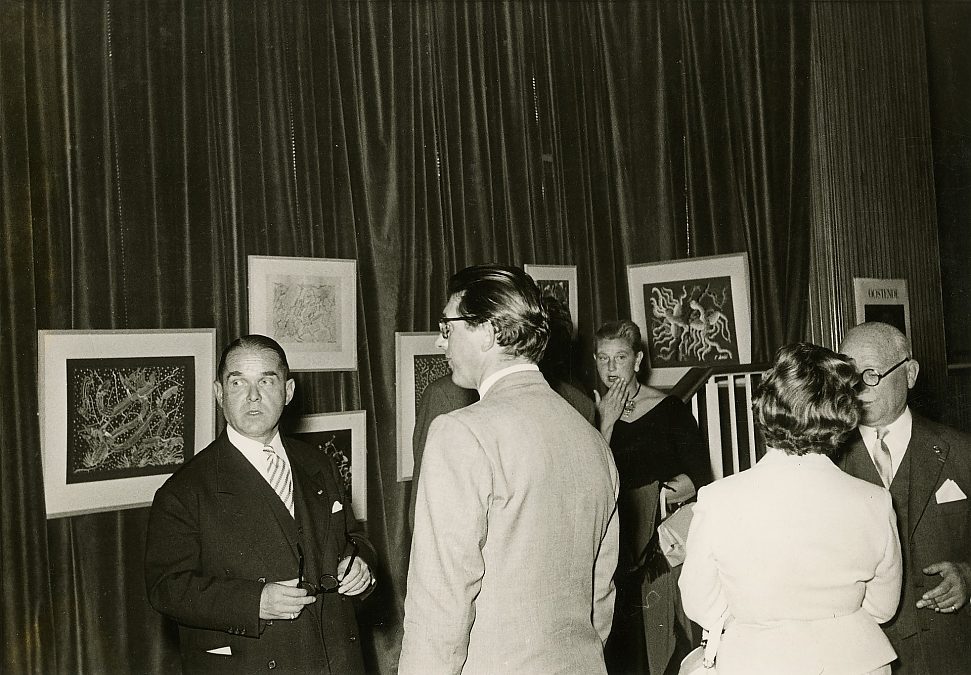
The owner was Congolese. The arrangement has taken citizenship.
The miracle he does not count
Each of Magnin’s miracles has, on the other side of it, a Congolese artist who did the work, and the sentence is built so that the artist disappears. That grammar leaves room for one more miracle, the one Magnin does not count, which is his own.
In 1989 he met the collector Jean Pigozzi and described “my dream project: to discover art from Sub-Saharan Africa where there were no museums, galleries, or collectors, nothing but exceptional artists.” A continent with no institutions and a great deal of talent, waiting. It is the hut painter with his earth and charcoal again, scaled to a continent.
Pigozzi gave him, in his words, the green light. For twenty years, from 1989 to 2009, Magnin bought nearly ten thousand works for him, by his own count. They sit in Geneva, without a permanent venue. In 2009 he began selling instead, at the fairs, and “today those artists have a market that I played a role in creating.” His catalogue essay opens by calling the show the fruit of chance and necessity, and the chance was him.
Asked by Africultures that July whether the works would ever be shown in Congo, he said it would be a dream. He is not their owner. The conditions are not there. A watercolor in full light, he explained, fades in four months.
The precedent for moving Congolese objects out of the country by the thousand is the colonial state’s, and that collection is in Tervuren.
A man who has been the primary gatekeeper for a country’s art, describing that art as miracles performed by men like him, has described himself with some precision.
The quotation marks were the honest part.
The Lubaki and Hangar histories are told at length in Antoinette Lubaki essay and Hangar essay.
Comments