
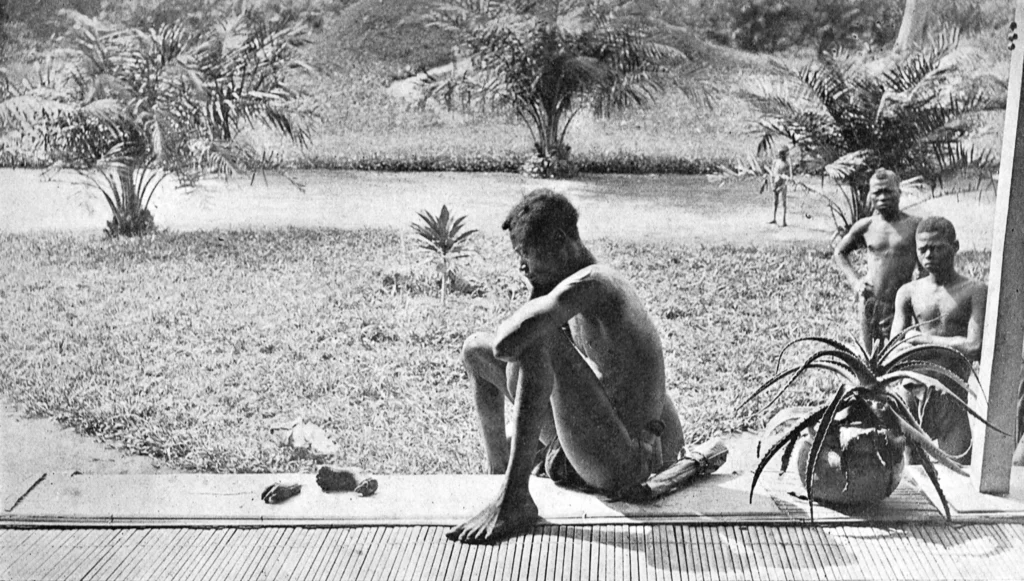
The photograph is quiet. A man sits on a mission veranda, looking at two small shapes laid on the boards before him. A child’s hand. A child’s foot. When E. D. Morel published the picture in 1904, the caption named the man, the village, the district, the company. It did not name the child. Her name was Boali. Look once more at how still it all is. Then step off the veranda.
On 13 May, the sentries came to Nsala’s village three days early. The quota was not ready. They cut limbs, took captives, and killed. Among the dead: Bonginganoa and her five-year-old daughter Boali. Bonginganoa was Nsala’s wife. Boali was his child. The record keeps almost nothing else of them.
A severed limb in that country was not excess. It was bookkeeping, and the book had two columns. A hand answered for a spent cartridge, proof for the officers that the bullet had gone into a person; limbs settled what a village still owed in rubber. Each was a receipt, and the whole concession had been taught to read one. The quota cost Boali her hand and her foot. The wounds killed her.
On the morning of the 14th, Nsala walked to Baringa carrying, wrapped in leaves, the limbs of Boali. A man in his position might have said nothing. Instead, he chose a direction: toward the one house that stood outside the company’s chain of command, kept written records, and housed a woman known to photograph what the sentries left behind. His route says he believed the evidence he carried had an address.
What was he hoping for? The record is silent. The path was the same path. The forest the same forest. The vines still bleeding where they had been cut the week before. Nothing had changed except that the leaves in his hands had grown warm against his skin, and the package that weighed almost nothing had become the heaviest thing in the world. He walked the way a man walks when the decision has already been made and the only remaining question is whether anyone at the end of the path will understand what he is carrying. The record preserves one sentence from him: that the child was his daughter.
Word ran ahead. Two boys reached the mission first. Alice Harris met the mourning father. The bundle was opened. The remains were recent, from a child of about five. Nsala said the child was his daughter. Somewhere in that hour, she asked him to sit.
She was thirty-three and had been photographing the district’s wounds for years. What she made that morning is composed like a portrait: the man upright, the remains on the boards, nothing raised above a whisper. The camera needed stillness, and he was still.
Seen cold, the picture can look like a second cruelty. What kind of person asks a father to sit for this the day after? The care in the framing does not soften it; the care is what makes you flinch. But the cruelty was already there. What the making added was severity. Grief, asked to compose itself.
The case against the Congo Free State was already photographic. Alice Harris’s own file showed the maimed alive, severed hands held up beside missionaries, a white finger pointing at what was missing, because a Congolese wound did not count until a white man stood next to it. Those pictures indict by display. This one displays almost nothing: two small shapes a viewer might pass over, and a man who cannot. Here the father’s looking does the pointing. The proof had already arrived with Nsala on the road. Alice made the image; what it captured was his to bring.
Within days, the image was a lantern slide. It entered Morel’s book, then the Congo Reform Association’s traveling lecture: sixty slides, five hundred meetings and more. In King Leopold’s Soliloquy, Mark Twain had Leopold rage at “the incorruptible kodak,” the one witness he could not bribe. Alice Harris traveled inside that apparatus and could argue with its captions. Nsala’s authority ended at the veranda.
In 1908, Leopold surrendered his private state to Belgium. The photograph was one instrument among others in that pressure. The Congo passed from a king to a country. The colonial relation stayed.
Two things are usually said about this image, and both are half the story. That a courageous Englishwoman exposed a crime, true enough; the exposure ran on her language, her network, her public. That a grieving African man was used by someone else’s camera, also true, and it forgets that the errand was his. The photograph exists because a father from Wala decided that his daughter’s limbs should not remain private receipts of the company’s shortfall. He carried them to the house that stood outside the company’s reach, the one place that kept records and produced images capable of leaving the forest.
Nsala is not known to appear in the record again. When Leopold’s Commission of Inquiry arrived, the mission reported that not one sentry had ever been punished. The record follows the photograph, edition by edition, hall by hall, for years. Of the man, it says nothing more. He came into the archive carrying the heaviest thing in the world and left it with one sentence: that the child was his daughter. That is what an archive is: a house where the evidence lives on and the witness cannot get a room. The photograph keeps him there still, sitting before the remains of his daughter. The sitting is all a photograph can keep. The walk stays outside the frame, and the walk is why there is a frame at all. The lecture tour was counted at five hundred meetings and more. Plus this one.
Comments